


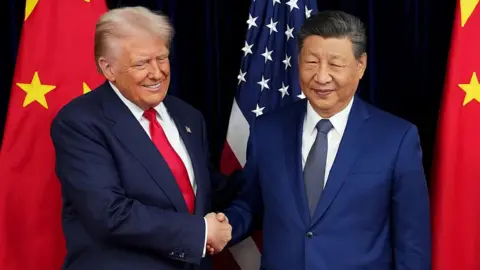
Former President Donald Trump has confirmed that he agreed to visit the Chinese capital in April and asked Chinese President Xi Jinping for a official visit later next year, following a phone call between the two leaders.
Trump and Xi—who held talks nearly a month ago in the Republic of Korea—discussed a series of matters including commerce, Russia's invasion of Ukraine, synthetic drugs, and the island of Taiwan, per the U.S. leader and Beijing's diplomatic corps.
"Bilateral relations is highly solid!" Trump wrote in a online message.
Beijing's press outlet released a announcement that indicated both states should "keep up the momentum, proceed in the positive way on the principle of fairness, respect and common gain".
Earlier Talks and Economic Agreements
The officials convened in Busan, South Korea in the fall, following which they reached a ceasefire on import duties. The US opted to reduce a 20 percent duty in half targeting the movement of fentanyl.
Tariffs remain on imports and average just below 50%.
"Afterwards, the China-US relationship has generally maintained a consistent and favorable course, and this is appreciated by the each side and the international community at large," the Chinese statement noted.
- America then pulled back a warning of double tariffs on products, while Beijing put off its intention to enforce its recent phase of limits on mineral exports.
Commerce Discussions
Official representative Karoline Leavitt stated that the Monday call with Xi—which lasted about an hour—was mainly about economic issues.
"We are pleased with what we've observed from the China, and they agree," she said.
Broader Topics
In addition to discussing commerce, Xi and Trump broached the subjects of Russia's invasion of Ukraine and the Taiwan situation.
Xi informed Trump that the island's "return to China" is essential for Beijing's perspective for the "world order following wars".
Beijing has been part of a foreign policy clash with Japan, a US ally, over the enduring "strategic ambiguity" on the authority of the independently administered island.
In the past few weeks, Japanese Prime Minister Sanae Takaichi stated that any assault from Beijing on Taiwan could lead to a reaction by Tokyo's army.
Trump, however, did not refer to the island in his Truth Social post about the conversation.
US Ambassador to Japan, George Glass, had earlier stated that the US backs the Japanese in the aftermath of Beijing's "coercion".


